

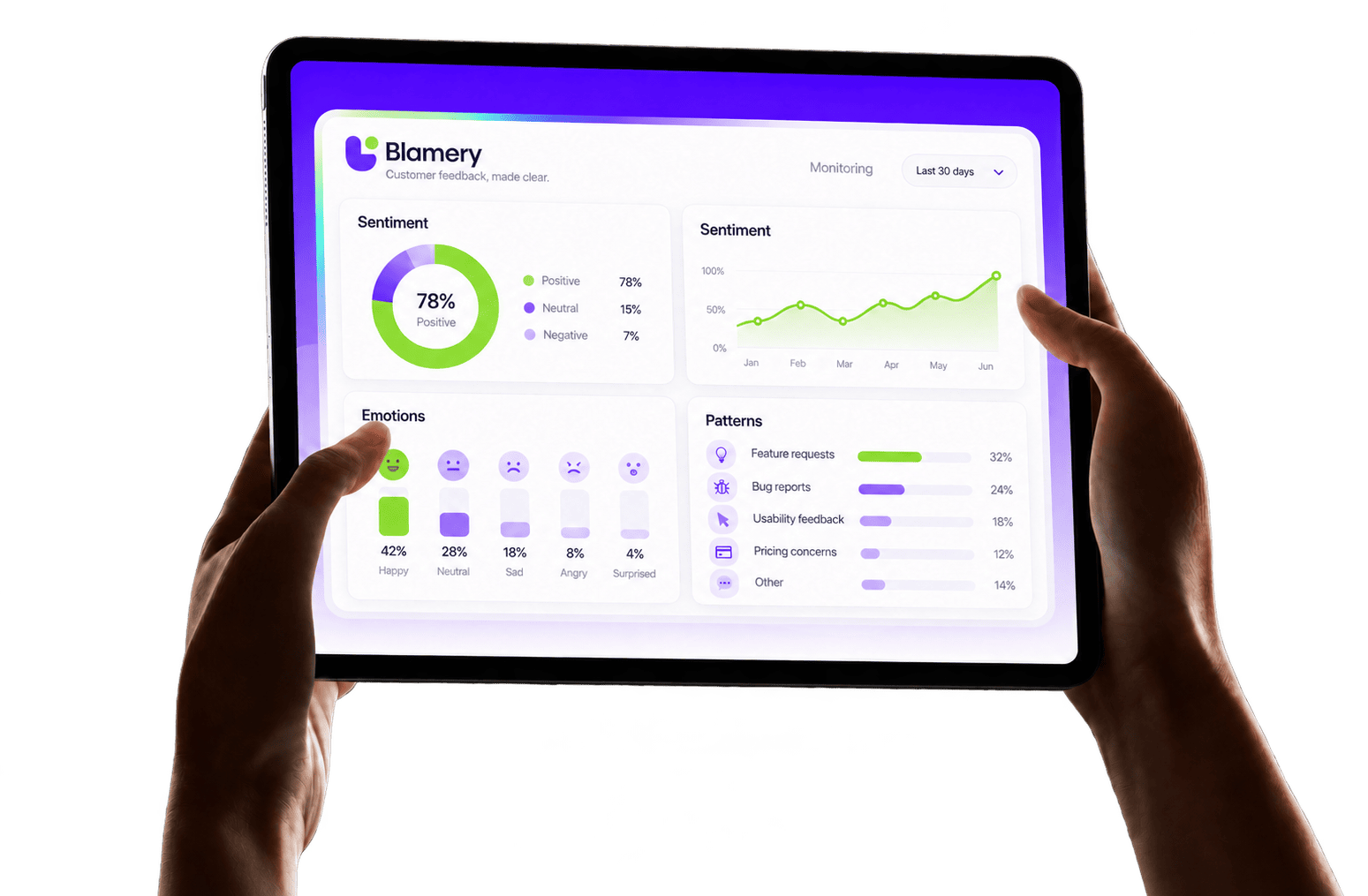


Brand perception is not what a company says about itself.
It is what people actually believe about the company after they see it, try it, hear about it, complain about it, recommend it, or warn their friends to stay away.
A brand can say, “We care about customers” on every page of its website. Very cute. But if the reviews say support is slow, the product feels confusing, and people keep using words like “frustrating,” then that is the real brand story.
Brand perception lives in the market, not in the meeting room.
It is shaped by customers, prospects, reviews, social posts, Reddit threads, blog mentions, comparison articles, AI answers, and word of mouth. In simple terms, it is the gap between what a company wants to be known for and what people actually remember.
And that gap matters.
What Is Brand Perception?
Brand perception is the collective impression people have about your brand.
It comes from what they experience, what they read, what others tell them, and what they see online. In other words, your brand is not only built by your website, your ads, or that “About Us” page everyone pretends to love.
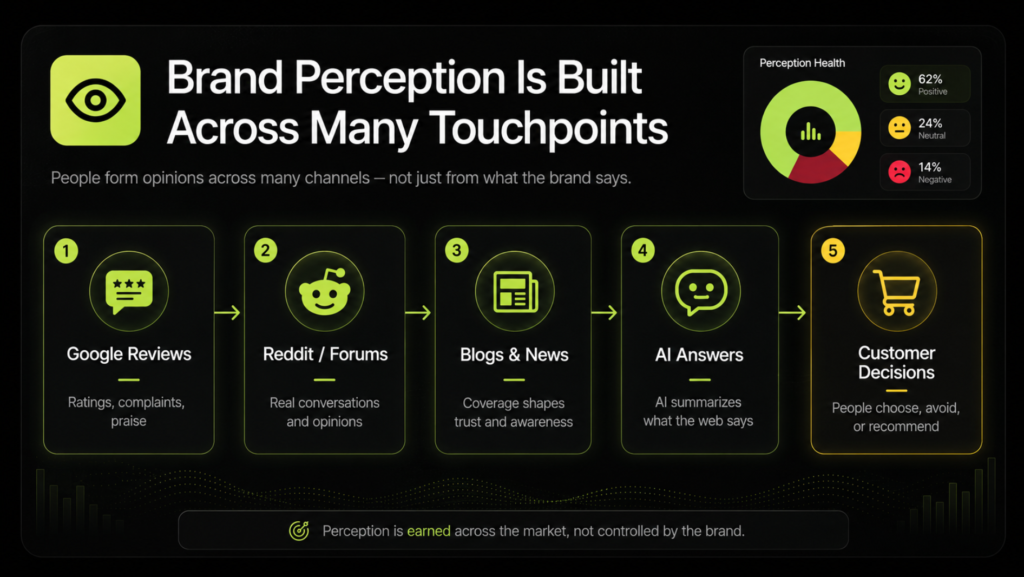
It is built everywhere people meet your brand.
A customer review. A Reddit thread. A blog post. A friend’s comment. A Google result. An AI answer that sums up your company in one cold little paragraph.
All of these touchpoints shape what people believe.
That belief may be fair, unfair, old, new, detailed, or wildly wrong. But it still affects whether people trust you, compare you, choose you, or quietly move on to a competitor.
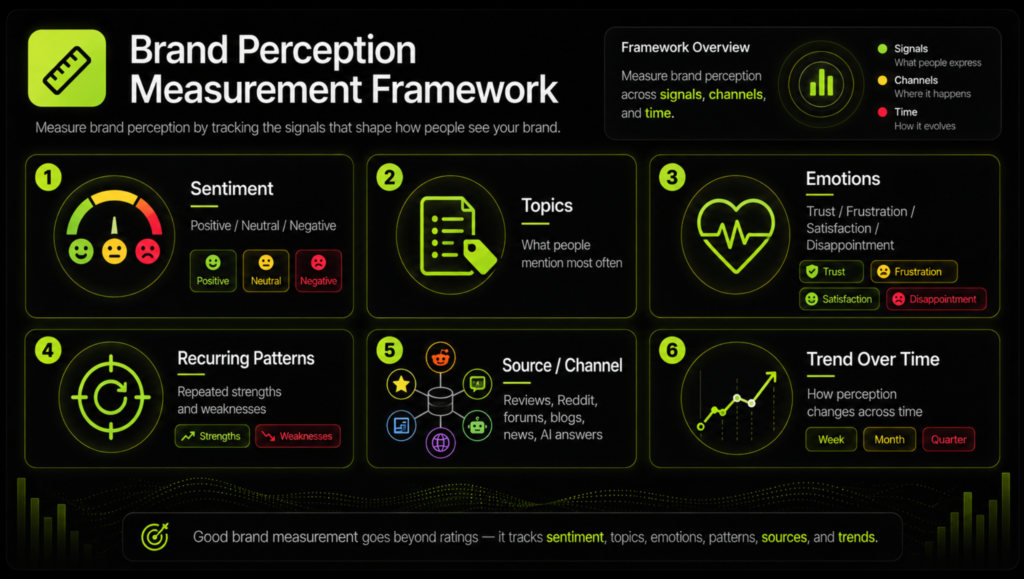
To understand brand perception, you need to look beyond simple “good” or “bad” feedback.
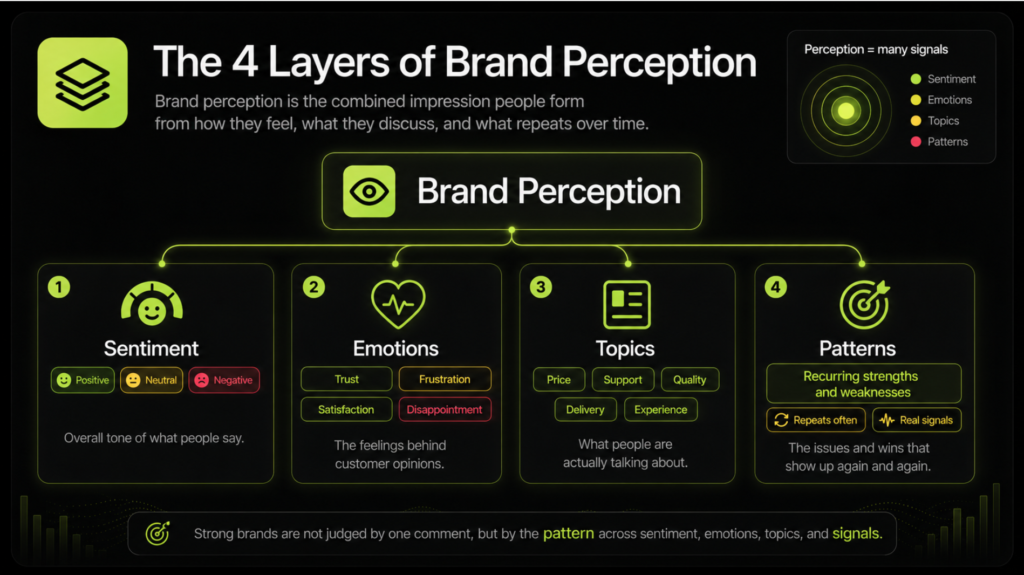
You need to break it into sentiment, emotions, topics, and recurring patterns.
Sentiment
Sentiment shows the general tone of what people say about your brand.
It tells you whether mentions are mostly positive, neutral, or negative. Simple enough, which is nice, because marketing people usually enjoy making simple things sound like rocket science.
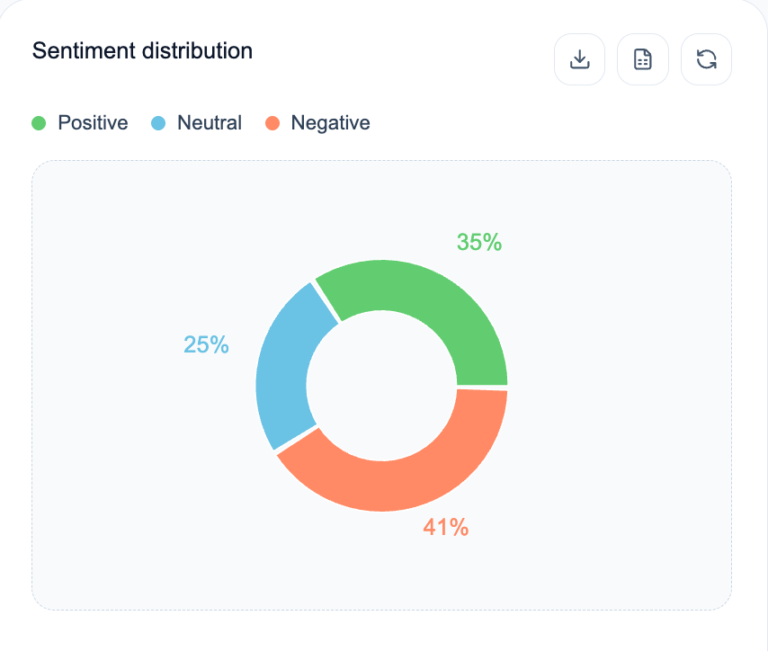
Positive sentiment means people are happy, impressed, or willing to recommend you.
Negative sentiment means people are unhappy, annoyed, or warning others. Neutral sentiment usually means your brand was mentioned without strong praise or anger.
But sentiment alone is not enough.
A brand can have mostly positive reviews and still have one serious problem hiding inside the feedback.
For example, customers may love the product but hate the support team, which is a bit like selling great lemonade through a window that slams on people’s fingers.
Emotions
Emotions explain how people feel, not just whether feedback is positive or negative.
Two negative reviews can look the same on the surface but mean very different things. One customer may feel angry, another may feel confused, and another may feel disappointed.
That difference matters.
Anger can point to broken promises. Confusion can point to unclear pricing, poor onboarding, or bad product pages. Disappointment often means the brand created high hopes and then tripped over its own shoelaces.
Positive emotions matter too.
Trust, relief, excitement, and confidence show what the brand is doing well. These are the feelings that turn a normal customer into someone who tells others, “Yes, use this one.”
Topics
Topics show what people are actually talking about.
They help group feedback into clear areas like price, support, quality, delivery, features, user experience, trust, or results. This matters because “people dislike us” is too vague to be useful.
You need to know what they dislike.
Maybe the product is fine, but delivery is slow. Maybe the support is great, but pricing feels unclear. Maybe people love the service but think the website looks like it was built during a lunch break in 2011.
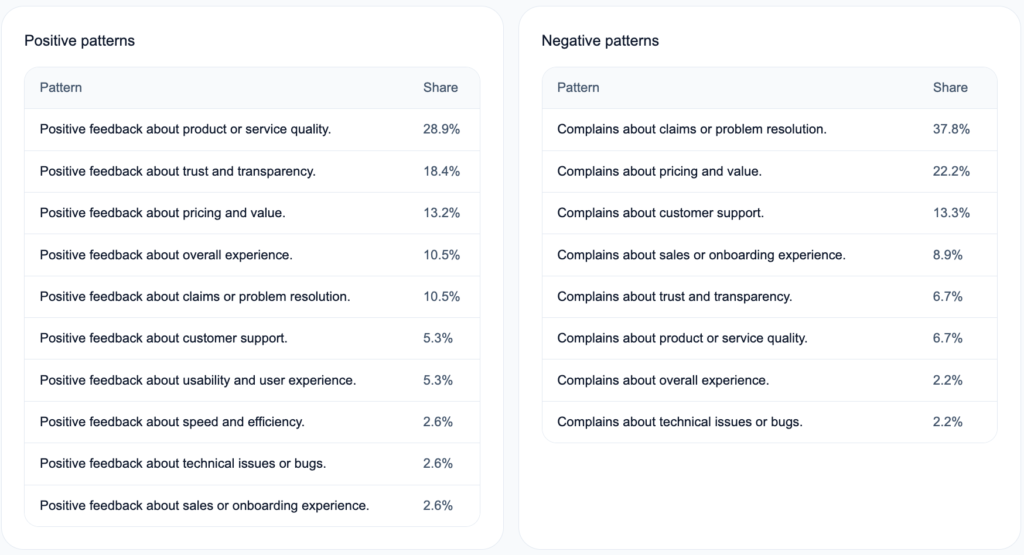
Topics help turn messy feedback into something you can act on.
They show which parts of the customer experience are helping your brand and which parts are quietly setting it on fire.
Recurring Patterns
Recurring patterns are the ideas, complaints, and praises that appear again and again.
One person saying your checkout is confusing may be random. Fifty people saying it is confusing is not random. That is a warning sign wearing a bright yellow jacket.
Patterns help separate noise from real signals.
They show what customers keep noticing across reviews, forums, articles, and AI summaries. These patterns are often where the most useful brand insights live.
For example, if people often mention “slow support,” “hidden fees,” or “easy setup,” those phrases become part of your brand image.
Not because your team wrote them in a brand guide. Because the market repeated them until they became the story.
That is why brand perception is not just a marketing topic.
It is a business reality.
It shows how people understand your brand, what they remember, what they trust, and what makes them hesitate before buying. And once you can see the sentiment, emotions, topics, and patterns clearly, you can stop guessing and start fixing the things that shape how the market sees you.
Why Brand Perception Matters
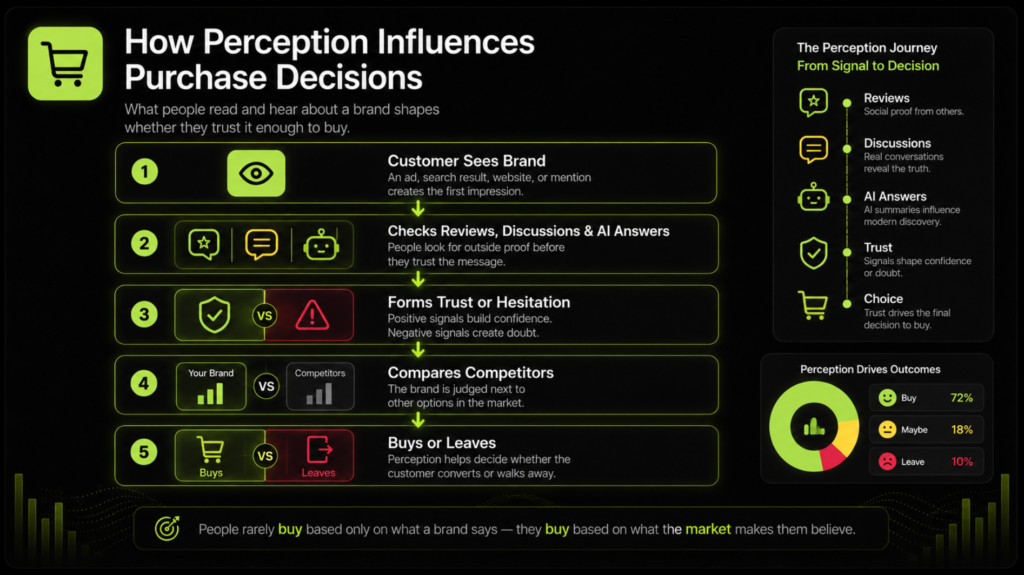
Brand perception matters because people do not make buying choices based only on what a company says.
They look at reviews. They read public talks. They compare stories from other customers. Then they decide if the brand feels safe, useful, risky, or not worth the trouble.
A company may think it controls the story.
Very sweet.
But the market usually has its own version.
Company assumption | Customer feedback reality |
Customers care most about price | Customers praise fast support |
Product quality is the main issue | Complaints are mostly about delivery |
Brand is seen as premium | Reviews mention unclear value |
People love our new feature | People barely mention it |
Support is “good enough” | Customers say support is the main reason they stay |
That gap is where useful insight lives.
Because once you know what customers really value, you can stop building your message around guesses. You can speak to what people already care about.
Brand Perception Across Different Channels
Brand perception does not live in one place.
It is not hiding only in Google Reviews. It is not sitting neatly inside your customer survey. It is spread across many channels, because customers apparently enjoy leaving clues everywhere like tiny unpaid detectives.
Each channel shows a different part of the brand story.
Google Reviews may show quick customer reactions. Reddit and forums may show deeper, messier talks. Blogs and news may shape public trust. AI answers may turn all of that online noise into one short summary that buyers actually read.
That means a brand can look strong in one channel and weak in another.
A company may have great Google ratings but bad Reddit threads. Or it may have good press coverage but poor reviews from real customers. Or, even worse, AI tools may describe the brand using old or wrong information because the internet never forgets and rarely cleans up after itself.
Google Reviews
Google Reviews often show the most direct customer feedback.
People use them to talk about service, quality, speed, price, staff, location, delivery, and whether they felt treated like a human being. Wild idea, I know.
These reviews matter because they are visible at the exact moment someone is searching.
A buyer may search for a brand, see the rating, scan a few comments, and decide in seconds whether the company feels safe. That is not a long customer journey. That is a tiny trust trial in public.
Reddit and Forums
Reddit and forums show a different kind of perception.
People are often more honest there because they are not writing a polite review for a star rating. They are asking questions, comparing brands, warning others, sharing stories, and sometimes arguing with the confidence of a lawyer who has watched one YouTube video.
This makes Reddit and forums useful for finding raw opinions.
Blogs and News
Blogs and news shape brand perception at a broader level.
They can make a brand look trusted, active, expert, risky, outdated, or invisible. Yes, invisible is also a perception. It says, “Nobody seems to care,” which is not exactly the dream.
Articles, reviews, roundups, rankings, and news mentions all add context.
AI Answers
AI answers are now part of brand perception too.
When people ask AI tools about a company, they may get a short summary based on reviews, articles, public data, forum posts, and other online signals. That answer can shape trust very fast.
This is important because AI often compresses a messy online reputation into a simple response.
If the web says people praise your support, AI may repeat that. If the web says your pricing is confusing, AI may repeat that too. Congratulations, your reputation has been turned into a paragraph.
Why Channel-Level Perception Matters
Looking at one channel is not enough.
A brand needs to understand how perception changes across Google Reviews, Reddit, forums, blogs, news, and AI answers. Each source shows a different angle of the same story.
Together, these channels show what people believe, what they repeat, and what future buyers are likely to see.
That is where tools like Blamery can help.
Instead of checking every channel by hand like a tired intern with twelve browser tabs open, Blamery helps bring these signals together. It can show sentiment, emotions, topics, and recurring patterns across the places where brand perception is actually being built.
Measuring Brand Perception in Practice
A simple brand perception review should answer these questions:
Question | What it tells you |
What is the overall sentiment? | Whether the brand is mostly seen positively, neutrally, or negatively |
What topics appear most often? | What people connect with the brand |
Which topics perform well? | What the brand can use in marketing and sales |
Which topics underperform? | What needs to be fixed or explained better |
What emotions are connected to the brand? | Why people trust, doubt, like, or dislike the brand |
How does perception change over time? | Whether the brand image is improving or getting worse |
This is also where tools like Blamery can help.
Instead of reading every review, forum thread, blog mention, and AI answer by hand like someone being punished for bad life choices, Blamery helps group brand signals by sentiment, emotions, topics, and patterns.
That makes it easier to see the full picture.
Not just what people say once.
What they keep saying.
Why Manual Review Analysis Is Not Enough
Manual review analysis sounds simple.
You open reviews, read comments, take notes, make a few groups, and pretend your brain is a clean data tool. Very brave. Also very easy to mess up.
The problem is not that manual work is useless.
The problem is that brand perception usually lives across too many places. Google Reviews, Reddit, forums, blogs, news, and AI answers do not politely sit in one folder waiting for you like trained puppies.
They are spread out.
And when feedback is spread out, manual analysis becomes slow, uneven, and hard to trust.
One person may focus on angry reviews because they feel loud. Another may notice positive feedback because they are in a good mood and had lunch. This is how “analysis” quietly turns into vibes with a spreadsheet.
Manual work also struggles with scale.
Reading 20 reviews is fine. Reading 2,000 reviews, forum posts, and article mentions is where the human brain starts asking for a new career.
The biggest risk is missed patterns.
Manual Analysis vs Blamery-Assisted Analysis
Manual review analysis | Blamery-assisted analysis |
Slow when review volume grows | Faster analysis across larger feedback sets |
Easy to become subjective | More structured view of sentiment, topics, emotions, and patterns |
Hard to scale across many reviews | Works across many reviews and public mentions |
Often misses repeated themes | Helps detect recurring strengths, complaints, and weak signals |
Usually checked channel by channel | Brings multiple sources into one clearer view |
Hard to compare topics over time | Helps track how perception changes across runs |
Depends heavily on who reads the data | Uses a more consistent analysis structure |
Good for reading examples | Better for finding the bigger picture |
Can be messy to report | Easier to turn findings into summaries, tables, and actions |
Often stops at “people like/dislike us” | Shows why people feel that way and what they mention most |
Final Thoughts
Brand perception is not what a company wants people to think.
It is what people actually believe after reading reviews, seeing public discussions, checking articles, asking AI tools, and hearing other people talk.
That belief can help the brand grow.
Or it can quietly block sales while the company keeps polishing headlines and wondering why buyers hesitate.
This is why brand perception should be monitored continuously.
Not once per year. Not only when something goes wrong. Not only when a bad review appears and everyone suddenly becomes very interested in “customer voice.”
Perception changes all the time.
New reviews appear. New complaints repeat. New strengths emerge. Competitors improve. AI answers shift. Public discussions move from one topic to another.
A strong brand does not just listen once.
It keeps watching the signals.
The goal is not to chase every comment or panic over every complaint. The goal is to understand the larger pattern: what people trust, what they doubt, what they value, what annoys them, and what keeps showing up again and again.
That is where real brand insight lives.
Not in the slogan.
Not in the deck.
Not in the “we are customer-first” line that every company uses until the words lose all meaning.
It lives in the market.
And the brands that measure that perception early, often, and across channels have a much better chance of fixing weak spots, using real strengths, and showing up with a message people actually believe.