


We studied public discussions of dental insurance in the United States to understand which experiences shape perceptions of coverage and service. Our research examines recurring concerns across plan choice, dental care needs, provider access, claims and bills, with a focus on what the accounts establish and what they leave unresolved.
We collected publicly available social-media discussions and other public online accounts identified from November 1 to 10, 2026. This short evidence snapshot is not a trend study or a population estimate, and we retained source-reported patterns supported by at least two independent accounts.
Plan Choice, Dental Network & Coverage Confidence
We examine how people describe understanding dental coverage and benefit limits, including annual maximums, and consider how cost and provider networks can shape perceptions of plan value. We ask what the discussions show about confidence in coverage before care, distinguishing difficulty understanding terms from evidence about why someone chose a plan or whether that choice was constrained. We also distinguish plan terms from evidence about constrained alternatives.
Dental Need, Eligibility Checks & First Response
We examine what people describe when a dental need arises and ask what the evidence shows about eligibility checks, expected coverage, initial contact and information about next steps. We distinguish the need for care from an insurance interaction, and an estimate or coverage inquiry from a confirmed decision, treatment outcome or final cost. We also consider whether initial information is described as provisional or conclusive.
Access to Dental Care, Treatment Approval & Service Experience
We examine provider search and support during efforts to access dental care, including what the evidence establishes about network availability, approval processes, coordination and communication. We distinguish a stated need to find a dentist from a confirmed network barrier, delayed treatment, authorization problem or completed service. We also separate insurer support from actions by dental offices and providers.
Claims Resolution, Billing & Payment Fairness
We examine reported claim decisions, processing concerns, billed amounts and uncertainty about payment responsibility. We distinguish a reported denial from its cause, a processing concern from an assigned party’s error, and an initial estimate from the final claim decision and amount paid. We also consider whether reports distinguish estimates, claim decisions and final financial responsibility.
These stages organize separate evidence and do not imply that the discussions trace one person through a complete journey. The recurring themes concern coverage understanding and limits, dental needs and provider searches, and claims and billing, with important questions remaining at each stage.
Plan Choice, Dental Network & Coverage Confidence
Public discussions point to difficulty understanding dental insurance, alongside descriptions of annual maximums that cap covered benefits. The collection offers a short snapshot from the United States during November 2026, rather than evidence of a long-term trend or market prevalence.
We found a broad concern about understanding coverage and a separate description of a plan limit. These signals raise questions about coverage confidence, but do not tell us why someone selected a plan.
The cloud captures general discussion of difficulty understanding dental insurance and descriptions of annual benefit caps. The first pattern does not specify which terms are unclear, while the second describes a coverage limit rather than a particular claim denial or expense.
When coverage terms are hard to interpret
The reported comprehension difficulty identifies uncertainty at a broad level, but the evidence does not name confusing terms such as deductibles, waiting periods or service categories. We can identify a need to examine how plan information is explained, but cannot say which wording or decision caused difficulty.
Annual maximums describe a limit, not a claim outcome
Public material describes annual maximums as limits on the benefits a plan will cover. It does not connect a cap to a specific treatment, show that anyone reached one or establish an out-of-pocket consequence.
What the discussions establish about plan choice
Neither pattern establishes whether someone actively chose a plan, received coverage through an employer or family, or had a meaningful choice among options. The evidence points to concerns about understanding coverage and recognizing a benefit limit, without explaining why a particular plan was selected.
What customers should clarify
What services and plan terms does the coverage explanation include, and how are annual maximums described before care is planned? If a plan choice was limited or assigned, what information explains the options that were available?
* Evidence limits: These are recurring source-reported patterns, not independently verified identities or evidence of market prevalence. The available material does not establish a particular plan choice, which terms people found unclear or a financial consequence of an annual cap.
Dental Need, Eligibility Checks & First Response
A recurring first-hand signal describes a tooth problem that creates a need for care. The evidence does not establish what happened during an initial insurance interaction or whether insurance became part of the experience.
A reported tooth problem makes a need for dental care visible. It does not show whether the person checked eligibility, contacted an insurer or faced a coverage dispute.
The cloud’s recurring pattern describes a first-hand tooth problem, a concrete reason someone may need care. It provides context for this stage but says nothing about an eligibility check, first contact or next step.
A care need is documented, while the first response remains unknown
The account establishes that the writer experienced a problem with a tooth, supporting a finding about dental need rather than a specific insurance event. It does not identify the care sought or whether the person checked eligibility, contacted an insurer or dental office, or requested an estimate.
The care need does not establish a coverage barrier
A tooth problem can be the context for coverage questions, but this evidence does not connect the reported need to a network obstacle, treatment delay or insurance decision. Treating the need itself as proof of friction would turn an unknown interaction into a finding the source does not support.
The treatment and financial outcomes are unresolved
The source does not say whether treatment occurred, what the first response was, or whether the need affected timing or cost. This stage therefore documents a reason care may be sought, not how insurance handled the situation.
What customers should clarify
What care was sought, and was eligibility or expected coverage checked before treatment? If the process continued, what account could clarify who responded, what next step was given, and whether treatment or cost was affected?
* Evidence limits: We collected this material during a ten-day window, so it is a snapshot rather than a trend or estimate of market prevalence. The recurrence is source-reported, and document identities are not independently verified.
Access to Dental Care, Treatment Approval & Service Experience
A recurring first-hand signal is a stated need to find a dentist. The evidence does not show whether insurance narrowed the options, whether a dentist was found or whether care was delayed.
The reported concern is a need to locate a dental provider. It does not establish a network failure or interrupted treatment.
The cloud centers on the need to find a dentist, a first-hand account of provider search rather than a confirmed problem with plan coverage. The source does not establish how that search ended or whether the need resulted from insurance.
A provider search does not establish a network barrier
The finding concerns a need to locate a dentist. It does not say that the person searched unsuccessfully or that an in-network provider was unavailable. We cannot attribute the search to network participation, coverage rules or another insurance mechanism.
The search outcome is unknown
The source does not report whether the person found a dentist, obtained an appointment or received treatment. A stated need to search therefore does not establish that access was ultimately blocked.
Provider search is distinct from treatment support
This pattern documents a search need, not help from an insurer or dental office, an approval decision or a treatment delay. Our research cannot establish what support was provided during the search or how it affected care.
What customers should clarify
Which dentists currently accept the specific plan, and how can someone check before scheduling? If a search does not produce an appointment, what support is available, and how can the person establish whether the obstacle is network participation or provider availability?
* Evidence limits: We collected this evidence in the United States during the short November 1 to 10, 2026 research window, so it is a snapshot rather than a trend or market-prevalence estimate. Reported recurrence does not establish independently verified identities, why a dentist was needed, whether insurance caused a barrier or whether care was obtained.
Claims Resolution, Billing & Payment Fairness
Public discussions describe denied dental claims, and one source-reported account is identified as first-hand. The material does not consistently explain why claims were denied, whether decisions changed or what the final financial responsibility was.
We found reports of denials and processing friction, alongside discrepancies between amounts attributed to insurance and amounts paid or owed. A denial, an information problem and a disputed amount do not establish who ultimately paid what.
The recurring concerns include denied claims, unspecified possible causes before filing, missing supporting documents, information errors during processing and mismatches between amounts attributed to insurance and amounts paid or owed. These are separate source-reported patterns, not a documented sequence in which one issue led to another.
Denials are reported, but reasons remain unclear
Some public discussions report denials without naming a reason, while another refers to possible causes before a claim is filed without identifying them. A separate discussion links missing supporting documents to denial, but does not say which documents were missing or who was responsible for providing them.
Processing friction does not establish a denial
Public discussions also identify patient or subscriber information errors as barriers to claims moving through review. They do not establish who introduced or corrected the errors, how long processing took, or whether claims were eventually denied or paid.
A disputed amount does not establish the final payment
A reported discrepancy between amounts attributed to insurance and amounts paid or owed points to uncertainty about a bill, but the source does not establish its cause or final settlement. The evidence cannot determine the insurer’s payment, any reimbursement, whether payment was partial or the remaining customer balance.
What customers should clarify
What reason and supporting information does a claim decision identify, and who is expected to provide or correct missing or inaccurate details? When amounts paid, owed or attributed to insurance do not match, what account explains the discrepancy and confirms the final balance?
* Evidence limits: We analyzed recurring source-reported patterns from public discussions found in the United States during the November 1 to 10, 2026 collection window, a snapshot rather than a trend or market estimate. The reports do not establish independently verified identities, one continuous customer journey, the cause of a denial or the final amount paid.
What the four stages add up to
In Plan Choice, Dental Network & Coverage Confidence, recurring signals concern difficulty understanding dental insurance and annual maximums that cap covered benefits. These findings point to uncertainty about coverage and limits, but do not establish why anyone selected a plan or a particular treatment expense.
At Dental Need, Eligibility Checks & First Response, a recurring first-hand pattern describes a tooth problem and establishes a need for care without documenting an insurance interaction or outcome. At Access to Dental Care, Treatment Approval & Service Experience, a separate pattern records a need to find a dentist but does not establish a network barrier or whether care was obtained.
At Claims Resolution, Billing & Payment Fairness, source-reported patterns describe denied claims, including discussion of missing documentation and information errors during processing. Other discussions describe discrepancies between amounts attributed to insurance and amounts paid or owed, while leaving the cause, final payment and financial responsibility unresolved.
Together, these are distinct signals across four stages, not evidence tracing one continuous customer journey or showing that insurance caused every reported difficulty. We collected the material during a short November 1 to 10, 2026 snapshot, and we do not pool counts across reports because overlap and unique episode identities are unknown.
This study does not rank companies or their branches. It helps companies identify reported gaps in product and service quality for further investigation and improvement.
Figures come from the analyzed public-review datasets. Overall review sentiment and sentiment within individual claims use separate denominators.
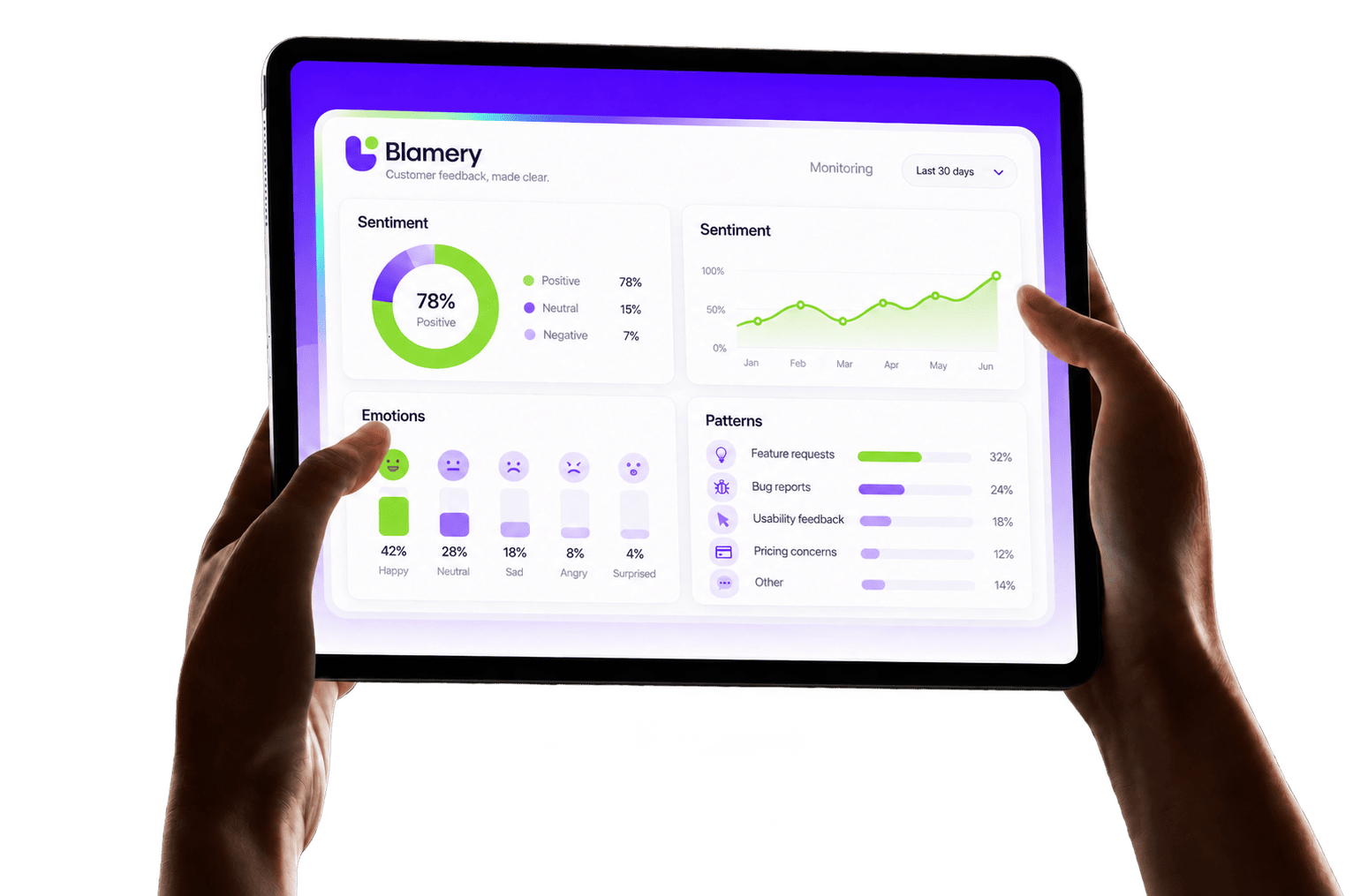
Blamery can run sentiment analysis and identify positive and negative patterns in public online feedback about your company or product, as well as competing companies or products. Explore the free demo, or contact us for custom marketing research.