


We collected publicly available social-media discussions about private health insurance in the United States during a two-week period in October 2026. We selected recurring patterns supported by at least two reported documents and analyzed them as exploratory themes for insurers and their product, member-experience, claims, billing, provider-network, and service leaders.
We treated this as exploratory thematic research, not a population estimate or a complete account of any customer’s journey. The four stages let us examine decision conditions, service processes, and claim-related financial questions without assuming that the same people experienced them in sequence.
Plan Choice, Network Access & Coverage Confidence
We examine how premiums, deductibles, copayments, coinsurance, covered services, exclusions, and provider-network boundaries may shape confidence before care. We ask what public discussions can tell us about plan conditions—including whether ambulance services are in network—and distinguish those terms from an individual’s reason for choosing a plan, available alternatives, understanding, or decision. This stage is designed to investigate those questions, not assume their answers.
Care Seeking, Eligibility Checks & First Response
We examine what a person may need to verify when seeking medical care, including eligibility, network status, expected coverage, referrals, and prior approval. We ask what a first insurer response might clarify, how instructions and next steps could be communicated across insurers, providers, pharmacies, and billing offices, and whether any initial result is documented. Stated requirements alone do not establish an individual check, contact, or care outcome.
Care Access, Authorization & Service Experience
We examine how coverage processes may intersect with actual access to care, including provider availability, authorization, communication, coordination, and support. We also ask what an expedited-review option means when waiting could seriously harm health, while distinguishing the existence of a procedural route from evidence that anyone requested or received assistance, experienced delay, or obtained treatment. Access, authorization, and delivered care are separate questions.
Claims Resolution, Billing & Payment Fairness
We examine claim denials and the roles that medical-necessity judgments, coding, authorization-related processing, appeals, and follow-up may play in public discussions. We ask whether accounts describe a denial, an appeal or other next step, or discontinued claim pursuit, while distinguishing these process concerns from established payment amounts, appeal resolutions, responsibility for coding, and customers’ ultimate financial outcomes.
Plan Choice, Network Access & Coverage Confidence
Public discussions point to a network limitation relevant to coverage confidence before care: ambulances are described as commonly out of network. The evidence does not establish why an individual chose a plan or what happened in a particular care episode.
The selected discussion describes an ambulance network limitation that may matter when understanding plan coverage. It does not document one person’s continuous journey or a specific service or bill.
The selected ambulance-network concern raises a practical question about whether ambulance services count as in network under a given plan. The source describes ambulances as commonly out of network, but does not identify a particular plan, location, service, or resulting bill.
Network boundaries matter before care is needed
An out-of-network ambulance limitation makes network terms relevant to coverage confidence before an emergency occurs. The material does not show that a specific person used an ambulance, faced an out-of-network charge, or experienced financial exposure.
Approval requirements are conditions, not outcomes
The selected material describes a network limitation, not what happened after a particular ambulance service was used. It does not establish an individual charge, claim, or care outcome.
Plan choice remains unresolved
The finding raises a question about network boundaries, but does not reveal whether people actively chose their plans or had alternatives. We cannot establish how anyone weighed premiums, cost-sharing, covered services, or provider access when enrolling.
What customers should clarify
Which ambulance services are considered in network under the plan, and what coverage applies when they are not? Where can a member check the applicable ambulance network terms before care is needed?
* Evidence limits: We collected evidence about public discussions of private health insurance in the United States during a two-week period in October 2026, so it is a snapshot rather than a trend or population estimate. The selected pattern does not establish individual plan choices or care outcomes.
Care Seeking, Eligibility Checks & First Response
The selected Stage 2 pattern describes a policy condition: certain services or treatments require approval before the plan covers them. It does not describe what happened when an individual needed care.
Approval requirements can make the steps before coverage applies important to understand. The stated requirement does not establish that a person checked eligibility, contacted the plan, or received a particular response.
The selected theme is approval before coverage for some services or treatments. This policy description flags a condition to clarify, but does not identify which services require approval in a specific case or document an individual interaction.
Approval is a coverage condition, not a recorded check
The evidence says approval is required before the plan covers certain services, but it does not show someone checking eligibility or learning whether a particular service was covered. A general requirement cannot establish what applied to an individual’s care.
The timing and instructions remain unclear
The pattern does not specify which services trigger approval, when someone must request it, or what instructions the plan provides. It raises a question about how people can identify the applicable requirement, rather than documenting a delay or access problem.
First response is not established
The study asks about first contact, response time, and initial results, but the selected evidence describes none of those events. We cannot establish which channel someone used, how quickly they received a response, or whether approval affected care.
What customers should clarify
Which services require approval, and when must it be secured for coverage to apply? What confirmation and next-step information is available before care, and how can someone distinguish an approval requirement from a final coverage or payment decision?
* Evidence limits: The selected material describes a policy condition, not an individual eligibility check, first contact, response time, or care outcome. Our two-week October 2026 collection is a snapshot, not a trend or population estimate.
Care Access, Authorization & Service Experience
The selected pattern describes a procedural option: people can request expedited review when waiting could seriously harm health. The material does not establish whether a particular person requested review, received timely treatment, or obtained assistance.
The evidence describes a route to request expedited review when waiting could seriously harm health. It describes an option, not what happened to an individual seeking care.
The selected pattern concerns requesting expedited review when waiting could seriously harm a person’s health. Public material discusses this as a procedural option, but does not report that anyone requested or received expedited handling.
Approval is a coverage condition, not proof of access
The selected material describes an option to request expedited review when waiting could seriously harm health. It does not show whether anyone made such a request, received assistance, or obtained care.
Expedited review is a route to request, not an observed intervention
The pattern describes the option to request expedited review when waiting could seriously harm health. It does not establish that a request was made, that assistance followed, or that expedited handling changed access to care.
The practical gap is what happens between rule and care
The selected pattern identifies a gap between the option to request faster review and the experience of getting treatment. The study cannot establish whether someone encountered a delay, received support, or obtained care.
What customers should clarify
If waiting could seriously harm health, how can someone request expedited review? What information or updates are available about that request, and how can a member distinguish making a request from receiving assistance or care?
* Evidence limits: We collected evidence in the United States during a two-week period in October 2026, so these findings are a snapshot rather than a trend or population estimate. The pattern describes a procedural option, not observed assistance or treatment outcomes, and does not establish that the same people experienced other stages of the insurance journey.
Claims Resolution, Billing & Payment Fairness
Recurring public discussion at the claims stage centers on denials, but the financial result often remains unclear. The patterns include claim denials and an adverse coverage decision described in a first-hand account, alongside discussion of medical-necessity decisions, coding accuracy, authorization-related processing, and follow-up after a denial.
The sources describe denials and further steps, including appeals and cases where claim pursuit stops. Those process descriptions do not tell us whether a denial changed, whether care proceeded, or how costs were divided.
The selected concerns connect claim decisions with procedural uncertainty afterward, but the evidence ranges from general discussion to first-hand accounts. They should not be read as one continuous sequence experienced by the same people.
When a denial is named, the grounds are not always clear
Sources describe claims being denied, including one first-hand account of an adverse coverage decision, but the reasons for most denials are unspecified. Separate general discussions cite medical-necessity judgments for procedures and magnetic resonance imaging coverage requests, without documenting whether care proceeded or a decision later changed.
Processing concerns can involve authorization or coding
Public material discusses authorization problems that can interfere with claim processing, but does not say that a particular claim was denied or treatment delayed. Other general discussions describe coding errors as a possible reason for denial and incorrect codes submitted by providers, without verifying an error in a particular case or identifying who would correct it.
A denial can lead to further steps, but not a known resolution
Sources describe appeals by individuals or a hospital, and general discussion says a denial may be followed by further steps. First-hand appeal activity does not confirm a reversal or payment, while separate discussions describe denied appeals and cases where people stop pursuing claims without explaining why or what followed financially.
What customers should clarify
What specific reason was given for a denial, and does the explanation identify a medical-necessity or coding issue when relevant? If an appeal or other follow-up occurred, what changed in the decision, and what amounts were ultimately paid by the insurer, provider, or customer?
* Evidence limits: The discussions do not establish most denial reasons, final payment amounts, or appeal resolutions. This short-window snapshot is not a prevalence estimate or long-term trend, and reported document support does not verify individual identities.
What the four stages add up to
At plan choice, public material points to uncertainty about whether ambulance services may fall outside a plan’s network. When people seek care, the evidence describes prior approval as a coverage condition, but does not document an individual eligibility check, first response, or care outcome.
At the access stage, public material describes a route to request expedited review when waiting could seriously harm health, but does not show that anyone used the route or received assistance. At claims resolution, recurring concerns include denials, medical-necessity decisions, possible coding problems, and follow-up such as appeals, while final payment amounts and appeal outcomes remain unclear.
These patterns point to different kinds of uncertainty at different points in the insurance journey, not a documented sequence experienced by the same people. Our two-week October 2026 collection is a snapshot rather than a trend or estimate of how common the issues are, and the reports do not identify unique episodes across reports, so we do not pool their counts.
This study does not rank companies or their branches. It helps companies identify reported gaps in product and service quality so they can improve them.
Figures come from the analyzed public-review datasets. Overall review sentiment and sentiment within individual claims use separate denominators.
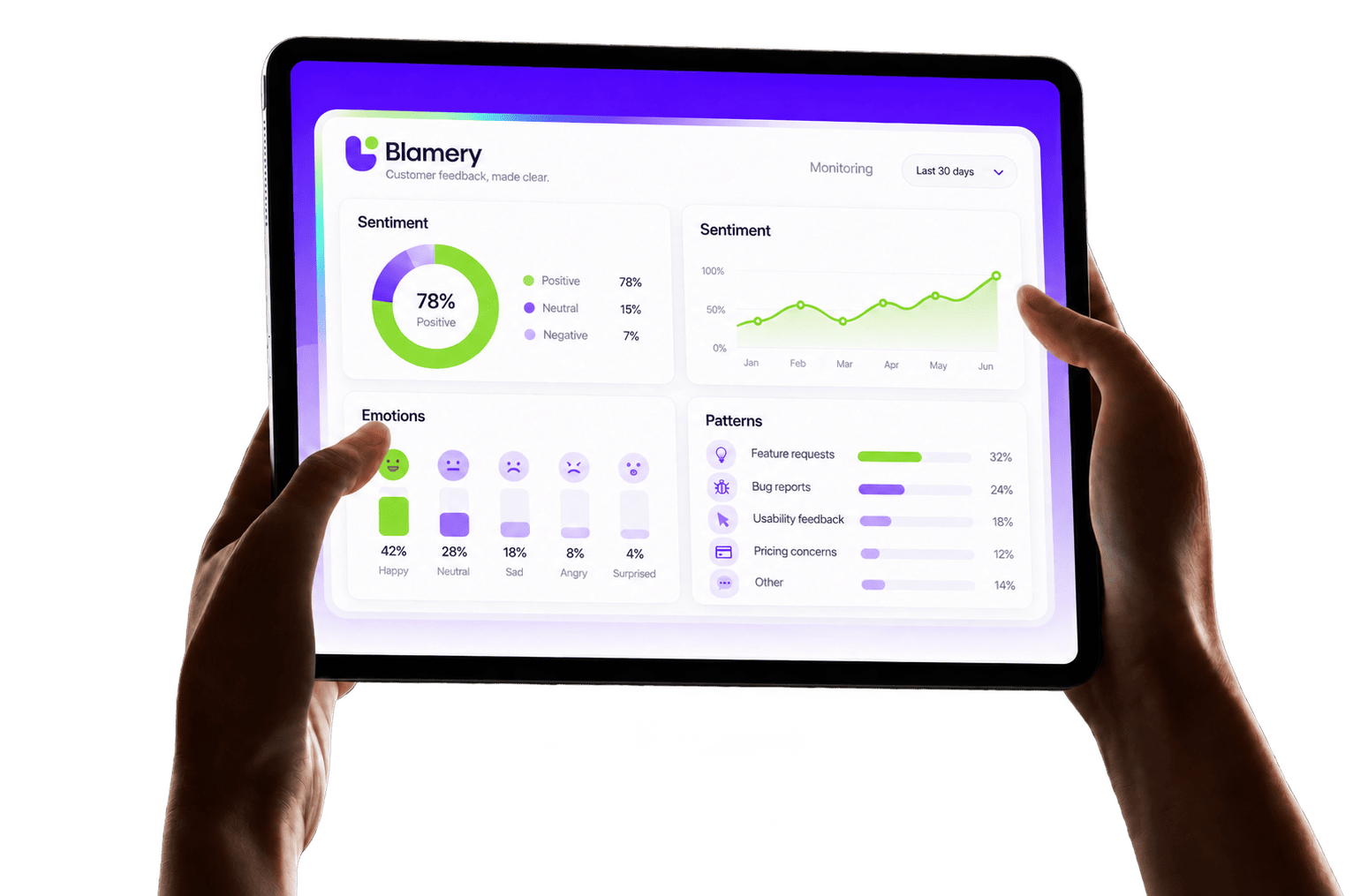
Blamery can run sentiment analysis and identify positive and negative patterns in public online feedback about your company or product, as well as competing companies or products. Explore the free demo, or contact us for custom marketing research.