


We studied publicly available reviews of eight car rental companies serving Fort Lauderdale-Hollywood International Airport to understand what customers describe as satisfying or frustrating. Our research examines whole-review sentiment, individual claims, and complaint themes as different ways of describing reported customer perceptions. A single tidy verdict would be convenient. Customer accounts, characteristically, have other plans.
We collected reviews our system found online in November 2026. To qualify, a company needed at least 3,000 publicly available reviews found for its service at Fort Lauderdale-Hollywood International Airport. The study covers ACE Rent A Car, Alamo Rent A Car, Avis Car Rental, Budget Car Rental, Enterprise Rent-A-Car, Hertz Car Rental, National Car Rental, and SIXT Car Rental. We did not establish when the reviews were published.
We classified sentiment both in whole reviews and in individual customer claims. A review receives one overall sentiment classification. A claim represents one part of what a customer says and can carry a different sentiment. We also examined recurring complaint themes and positive patterns, including themes that appear across companies or vary among them. The study identifies factors shaping reported customer perceptions. It does not determine a best provider.
Overall review sentiment across the researched datasets
Whole-review sentiment varied across the eight datasets. Positive classifications outweighed negative ones in the Avis, Alamo, Enterprise, National, and SIXT datasets. Negative classifications outweighed positive ones in the ACE Rent A Car, Budget, and Hertz datasets.
Avis had the highest positive share among reviews in these datasets, at 86%, and the lowest negative share, at 12%. Budget had the lowest positive share, at 25%, and the highest negative share, at 74%.
Neutral classifications were uncommon. The share of neutral reviews was highest in the National dataset, at 5.5%, and lowest in the ACE Rent A Car dataset, at 0%. The other cohorts ranged from 0.5% to 2%.
Sentiment within individual customer claims
Whole-review sentiment assigns one label to an entire review. Claim-level sentiment classifies individual positive, neutral, or negative details. The percentages here describe shares of classified claims, not shares of reviews or customers. A review can contain claims with different sentiments.
Positive claims made up a majority in the Alamo, Avis, Enterprise, National, and SIXT datasets. Avis had the highest positive-claim share, at 62.4%. Alamo’s share was 59.9%, Enterprise’s 58.5%, SIXT’s 57.4%, and National’s 54.1%.
Negative claims outnumbered positive claims in the other three datasets. The negative-claim share was 50.1% for ACE Rent A Car, 53.0% for Budget Car Rental, and 53.5% for Hertz Car Rental. Hertz had the highest negative-claim share, while Alamo had the lowest, at 17.7%.
Neutral claims were most common in the Budget dataset, at 29.0%, and least common in the Avis dataset, at 17.4%.
An overall negative review can still contain favorable details. Claim-level shares capture that mix, while whole-review sentiment summarizes the account as a whole. The measures answer different questions. Across the reviewed companies serving Fort Lauderdale-Hollywood International Airport, the balance of favorable and unfavorable claims varies substantially.
Complaint topics across the researched datasets
The most prominent complaint topic differs across the eight datasets. Product and service quality led among negative reviews in the National Car Rental dataset, at 34.2%. Claims resolution led in the Avis dataset, at 33.3%, while speed and efficiency led in the Budget dataset, at 27.7%.
Other datasets foregrounded different concerns. Pricing value and trust and transparency tied as ACE Rent A Car’s most frequent negative topics, each appearing in 23.4% of its negative reviews. Customer support led in the Enterprise Rent-A-Car dataset, at 31.3%. Product and service quality led in the Alamo Rent A Car dataset, at 31.3%, the Hertz Car Rental dataset, at 21.3%, and the SIXT Car Rental dataset, at 24.4%.
The shares also differ for comparable topics. Pricing value appeared in 23.4% of ACE’s negative reviews, the highest share for that topic, compared with 9.6% for Hertz, the next-highest. Trust and transparency appeared in 23.4% of ACE’s negative reviews and 16.2% of Hertz’s, the next-highest share. Customer support appeared in 31.3% of Enterprise’s negative reviews, the highest share, and 12.5% of Avis’s, the lowest.
These topic shares use negative reviews as their denominator. A review can describe more than one issue, so the percentages need not add to 100%. The topics show which concerns stand out within each set of reviews. They are not overall service ratings or a ranking of providers.
Top positive patterns by company
The leading positive patterns vary across the eight company datasets, though some themes recur. Pattern order reflects how frequently claims were assigned to each pattern. The percentages in this discussion describe the share of reviews in each company’s pattern summary, a different measure.
Vehicle condition and efficient processes stand out in the Alamo and National results. Cleanliness appeared in 11.0% of reviews in Alamo’s pattern summary and 12.0% in National’s. Alamo’s highest-ranked positive pattern by claim frequency concerned quick or easy drop-off, reported in 10.0% of reviews in its summary. Enterprise’s second-ranked pattern concerned a quick process, also appearing in 10.0% of reviews in its summary. Alamo’s pattern specifically names drop-off, while Enterprise’s refers to the process more generally.
Other leading patterns concern the vehicle, service, or the overall experience. Favorable car assessments and positive customer-service comments each appeared in 11.0% of reviews in Avis’s pattern summary. Budget’s top-ranked theme was a favorable car appraisal, appearing in 8.0% of reviews. Enterprise’s top pattern was strongly positive overall sentiment, found in 11.0% of reviews in its summary. Hertz’s first- and third-ranked patterns were favorable service assessments, appearing in 9.0% and 8.0% of reviews. National’s leading three patterns also included positive overall-experience descriptions alongside cleanliness.
Some of ACE’s and SIXT’s highest-ranked positive patterns describe favorable experiences involving an individual, alongside broader service praise. Positive service descriptions appeared in 10.0% of reviews in ACE’s pattern summary. Excellent or exceptional service appeared in 11.0% of reviews in SIXT’s. Across the datasets, positive patterns include cleanliness and speed as well as favorable descriptions of vehicles, service, and the overall experience.
Top negative patterns by company
The leading negative patterns vary in subject and emphasis across the eight datasets. Pattern order reflects how frequently claims were assigned to each pattern, while percentages describe reviews. A pattern’s rank therefore need not match its share of reviews.
In the ACE Rent A Car dataset, 9.5% of reviews described an experience as misleading or deceptive, 10.0% criticized customer service, and 9.5% characterized the situation as a scam. Alamo Rent A Car’s listed concerns included vehicle problems, described in 4.5% of reviews, an unpleasant odor, mentioned in 3.5%, and an unavailable reserved car type, reported in 2.5%.
Budget Car Rental’s top patterns included negative overall assessments in 11.0% and 10.5% of reviews, alongside dirty-car complaints in 9.5%. Hertz Car Rental’s leading themes were poor service, appearing in 9.5% of reviews in each of two separately classified patterns, and vehicle quality, appearing in 8.5%. Enterprise Rent-A-Car’s top three patterns spanned general dissatisfaction, car issues, and customer service. National Car Rental’s included disappointment, negative experience, and waiting for a vehicle.
Avis Car Rental’s listed themes included waiting to obtain a car and broader dissatisfaction. SIXT Car Rental’s included an unpleasant experience and poor service. Negative patterns range across trust, service, vehicle condition, and fulfillment, with different concerns prominent in different datasets. A review can describe more than one issue, so pattern percentages should not be added as though they counted separate reviews.
What the combined findings reveal
Whole-review sentiment, sentiment in individual claims, and complaint topics each describe a different part of customer feedback. Read together, they show varied perceptions across the analyzed datasets.
Avis Car Rental had the highest positive whole-review share in these datasets, at 86.0%, and a 12.0% negative share. Budget Car Rental had the lowest positive share, at 25.0%, and a 74.0% negative share. These figures summarize the overall tone assigned to reviews, not every detail they contain.
The claim-level balance differs. Positive claims made up 62.4% of Avis’s classified claims, while negative claims accounted for 53.0% of Budget’s. Negative claims also formed a slight majority in the ACE Rent A Car and Hertz Car Rental datasets. Positive claims formed a majority in the Alamo, Enterprise, National, and SIXT datasets. A review may contain favorable and unfavorable details, so its overall label need not match the sentiment assigned to each claim.
Complaint profiles vary as well. Among negative reviews, product and service quality appeared in 34.2% of National’s set, claims resolution in 33.3% of Avis’s, and speed or efficiency in 27.7% of Budget’s. In ACE’s negative reviews, pricing value and trust or transparency each appeared in 23.4%. The comparable shares for Hertz were 9.6% and 16.2%. A negative review can describe more than one issue, so topic shares do not add up to a single total.
Positive comments also return to practical details. Cleanliness appeared in 11.0% of Alamo reviews and 12.0% of National reviews. Quick or easy drop-off appeared in 10.0% of Alamo reviews, and a quick process appeared in 10.0% of Enterprise reviews. These repeated themes sit alongside company-specific complaint profiles.
ACE Rent A Car: positive and negative experiences
ACE Rent A Car’s leading positive patterns include favorable service descriptions, which appeared in 10.0% of reviews in this dataset, and favorable mentions of Nina and George, each appearing in 5.0%. The pattern labels do not establish Nina’s or George’s roles. We treat them only as named subjects of favorable comments.
Negative patterns include criticism of customer service, appearing in 10.0% of reviews, and descriptions of misleading or deceptive experiences and characterizations of the situation as a scam, each appearing in 9.5%. These are reported perceptions captured by the pattern analysis. They are not independent findings that deception or a scam occurred.
Service appears in both positive and negative patterns, so the dataset contains differing accounts rather than one uniform impression. The positive and negative pattern percentages describe reviews in this ACE dataset. Claim counts are a separate measure. Neither measure represents every rental or customer. These patterns show how favorable and unfavorable impressions coexist, without establishing why they differ or ranking ACE against other companies.
Alamo Rent A Car: positive and negative experiences
Alamo’s positive patterns pair convenience with vehicle condition. Cleanliness ranked second by claim frequency and appeared in 11.0% of reviews. Quick or easy drop-off ranked first and appeared in 10.0%. A broadly positive rental experience appeared in 9.5%. Claim rank and review share are separate measures, so their orders need not match.
In the Alamo dataset, 83.0% of reviews were positive, 16.0% negative, and 1.0% neutral. This overall balance does not erase specific criticisms. Pattern findings capture particular reported experiences, while whole-review sentiment assigns one label to each review.
The leading negative pattern by claim frequency concerned an unpleasant odor in the car, reported in 3.5% of reviews. Vehicle problems ranked second by claim frequency and appeared in a larger share of reviews, 4.5%. An unavailable reserved car type ranked third and appeared in 2.5%. The rank order and review shares answer different questions.
The results pair positive recognition of cleanliness and an easy return process with complaints about vehicle condition, odor, and reservation fulfillment. The dataset records favorable overall sentiment alongside distinct reported problems.
Avis Car Rental: positive and negative experiences
In the Avis dataset, 86.0% of reviews were positive, 2.0% neutral, and 12.0% negative. Positive assessments of the car and customer service each appeared in 11.0% of reviews. Positive appraisals associated with Erin appeared in 5.0%.
These percentages describe the share of reviews containing each pattern. Pattern rankings reflect how frequently claims were assigned to each pattern, a different measure. The named appraisal pattern reflects reviewers’ positive appraisals associated with Erin, not evidence of a particular role.
Reviewers’ dissatisfaction with Avis appeared in 3.0% of reviews. Reports of waiting to obtain a car and broader dissatisfaction with the experience each appeared in 3.5%. The profile includes general negative appraisals and a specific concern about waiting.
Favorable whole-review sentiment sits alongside distinct positive and negative details. Whole-review sentiment and patterns within reviews provide related but different views of customer perception.
Budget Car Rental: positive and negative experiences
Budget’s positive patterns concern the vehicle and reviewers’ overall experience. In this dataset, 8.0% of reviews described the car as good, fine, or great, making it the most frequent of the three leading positive patterns. Positive descriptions of staff interactions appeared in 6.5% of reviews, while 5.5% described the experience as very positive.
Among reviews in the Budget dataset, 11.0% described the experience as bad and 10.5% rated it negatively. Dirty-car complaints appeared in 9.5% of reviews. The leading patterns combine broad dissatisfaction with a specific concern about vehicle cleanliness.
Whole-review sentiment in the Budget dataset was 74.0% negative, 25.0% positive, and 1.0% neutral. At the claim level, 53.0% were negative, 18.1% positive, and 29.0% neutral. A review can contain several observations, so its overall sentiment need not match the sentiment assigned to each claim.
Positive comments about the car and staff interactions appear alongside broad negative assessments and cleanliness complaints. The measures capture different aspects of the reported experiences in this dataset.
Enterprise Rent-A-Car: positive and negative experiences
In the Enterprise dataset, 82.0% of reviews were positive, 16.0% negative, and 2.0% neutral. Strongly positive descriptions appeared in 11.0% of reviews. Quick-process comments and positive feelings toward Enterprise each appeared in 10.0%. Pattern rankings reflect how frequently claims were assigned to each pattern. These percentages describe the share of reviews assigned to each pattern.
General dissatisfaction with the experience appeared in 7.0% of reviews. Car-related issues followed at 5.5%, and dissatisfaction with customer service appeared in 4.0%. These labels describe an overall unfavorable assessment, a car-related problem, and dissatisfaction with customer service. They summarize classified patterns, not individual narratives, and do not establish specific incidents or explain why an experience unfolded as it did.
Positive and negative pattern shares are not opposite ends of one scale. Each measures how often a description was classified, while whole-review sentiment assigns one overall label. The separate summaries do not establish whether particular positive and negative patterns appeared together in the same review. The Enterprise dataset therefore combines a predominantly positive whole-review picture with specific positive and negative descriptions. Whole-review sentiment and the details reviewers emphasize offer related, distinct views of reported experiences.
Hertz Car Rental: positive and negative experiences
Hertz’s three leading positive patterns are favorable ratings, generally positive descriptions of the rental experience, and descriptions of the service as very good. They appeared in 9.0%, 6.5%, and 8.0% of reviews in this dataset, respectively. Pattern rankings reflect how frequently claims were assigned to each pattern. The percentages describe the share of reviews associated with each pattern.
Whole-review sentiment in the Hertz dataset was 68.0% negative, 30.0% positive, and 2.0% neutral. At the claim level, 53.5% of classified claims were negative, 20.8% positive, and 25.7% neutral. A review can contain multiple claims, including favorable and unfavorable details, so these measures can diverge.
Poor customer-service descriptions and general ratings of the service as poor each appeared in 9.5% of reviews in the Hertz dataset. Poor vehicle quality appeared in 8.5%. The two service labels are close in meaning. Vehicle quality describes a different aspect of the rental experience.
The positive patterns capture broad favorable judgments, while the leading negative patterns name service and vehicle concerns more directly. These measures describe different reported experiences. They do not rank Hertz or its branches against other providers.
National Car Rental: positive and negative experiences
National’s positive patterns lead with favorable overall impressions, followed by vehicle cleanliness and positive descriptions of the rental experience. The overall-experience pattern ranked first by claim frequency and appeared in 10.5% of reviews. Cleanliness appeared in 12.0%, and positive descriptions of the rental experience in 10.5%. Review shares measure how often a pattern appeared. The ranking reflects claim frequency.
Disappointment leads the negative patterns, appearing in 5.5% of reviews. A broader report of a negative experience appeared in 4.0%, while waiting to obtain a rental vehicle appeared in 2.5%. The leading labels range from an overall reaction to a specific reported service experience.
Positive accounts often recognize cleanliness and favorable experiences. The leading negative patterns describe disappointment and, less frequently, waiting for a vehicle. These are classified patterns in the National Car Rental dataset, not a verdict on every customer or rental.
SIXT Car Rental: positive and negative experiences
In the SIXT dataset, 79.0% of reviews were positive, 20.5% negative, and 0.5% neutral. At the claim level, 57.4% of classified claims were positive, 25.1% negative, and 17.5% neutral. A review may contain several claims, including favorable and unfavorable points, so its overall sentiment need not match the sentiment of each part.
Positive-pattern rankings reflect how frequently claims were assigned to each pattern. The percentages describe how often each pattern appeared among reviews in this dataset. The highest-ranked pattern by claim frequency concerned a positive assessment of dealing with Omar and appeared in 4.5% of reviews. Praise for excellent or exceptional service appeared in 11.0% of reviews, while strongly positive service descriptions appeared in 10.5%. Claim frequency and review shares measure different things.
A generally unpleasant experience was the most common negative pattern, appearing in 7.0% of reviews in the SIXT dataset. Poor customer service and descriptions of service as unacceptable or very poor each appeared in 4.0%. The leading patterns capture broad dissatisfaction and specific criticism of service. They do not imply that every negative review raised the same issue.
Whole-review sentiment in the SIXT dataset was mostly positive, while negative claims and complaint patterns capture other parts of reported experience. Review sentiment, individual claims, and complaint patterns are related measures, not a single verdict on a company.
What the findings add up to
The eight datasets show varied reported experiences across the companies reviewed. Whole-review sentiment, individual claims, complaint topics, and recurring patterns each describe a different part of customer feedback.
At the whole-review level, Avis Car Rental had the highest positive share, at 86.0%, while Budget Car Rental had the lowest, at 25.0%. Budget also had the highest negative share, at 74.0%, compared with Avis’s lowest share, 12.0%. Whole-review labels do not capture every favorable or unfavorable detail. At the claim level, positive claims made up 62.4% of Avis’s claims, while negative claims accounted for 53.0% of Budget’s. A whole-review classification describes a review. Claim-level sentiment describes individual points. The measures classify different units and need not align.
Complaint profiles add further detail. Among negative reviews in the ACE Rent A Car dataset, pricing value and trust or transparency each appeared in 23.4%. For Hertz Car Rental, the corresponding shares were 9.6% and 16.2%. Other leading concerns varied: product and service quality stood out for National Car Rental, claims resolution for Avis, and speed or efficiency for Budget. One negative review can describe more than one issue, so these topic shares do not add up to 100%.
Positive feedback also returned to practical details. Cleanliness appeared among the leading positive patterns for Alamo Rent A Car and National Car Rental. Quick processes or drop-off featured for Alamo and Enterprise Rent-A-Car. The findings describe varied reported experiences. They do not establish why the patterns differ. This study does not rank companies or their branches. It helps companies identify reported gaps in product and service quality so they can improve them.
Figures come from the analyzed public-review datasets. Overall review sentiment and sentiment within individual claims use separate denominators.
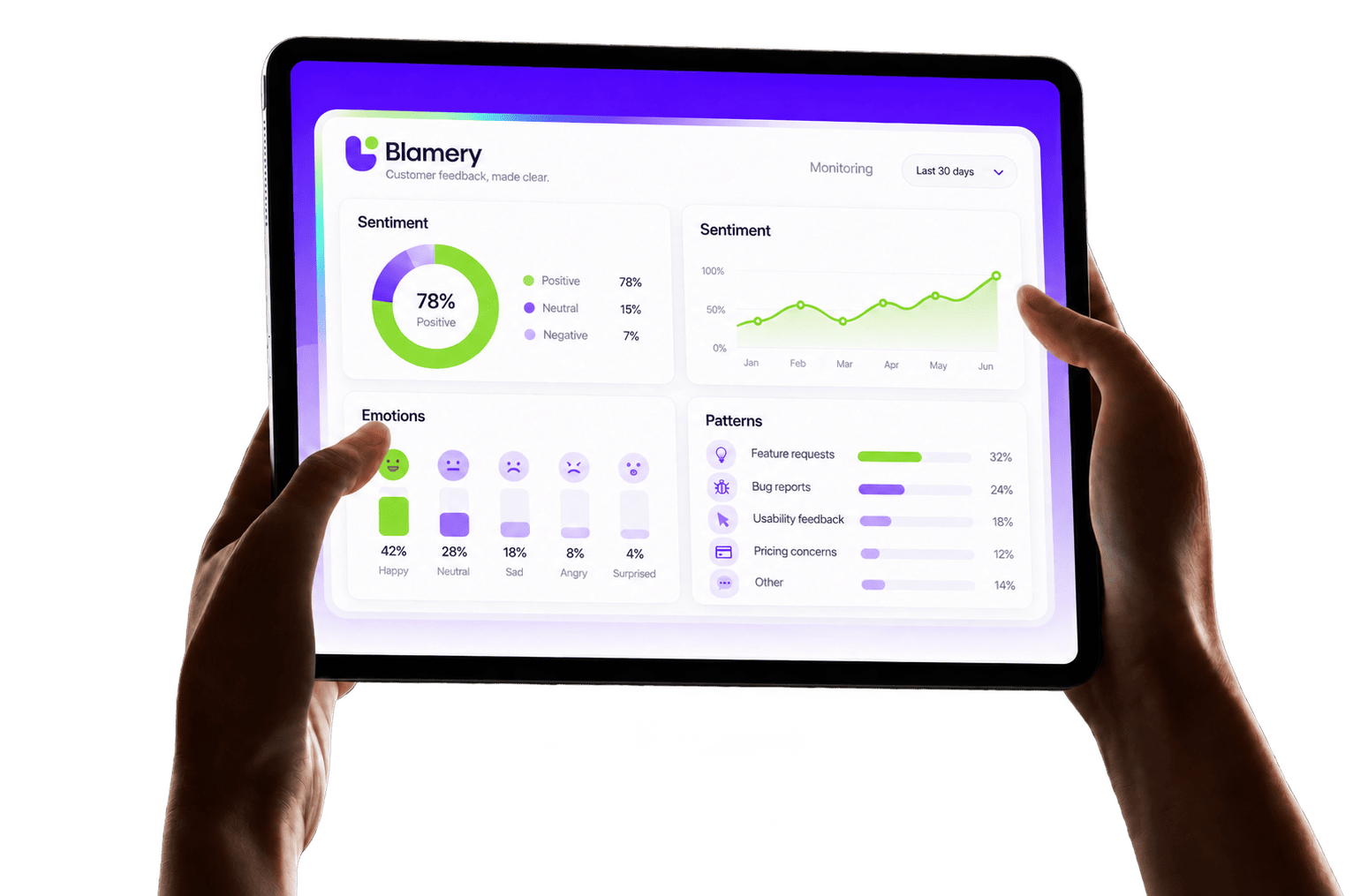
Blamery can run sentiment analysis and identify positive and negative patterns in public online feedback about your company or product, as well as competing companies or products. Explore the free demo, or contact us for custom marketing research.